
Five questions, one page
The section is five bands, each headed by its question and carrying its own tiles and registers. Each band reads all clear, on watch or failing, and the number beside the section in the sidebar is the count of failing checks.
| Question | What it counts |
|---|---|
| 1. Can a delay travel through this network? | Open ends, isolated activities, dangling starts and finishes, milestone logic, logic density, and the queue of work riding the data date |
| 2. Is the logic honest? | Finish-to-start share, start-to-finish links, leads, lags, the relationship mix and the lag profile |
| 3. Where does the risk concentrate? | Merge points, critical merge points, burst points, duplicate links, identical activity names and redundant (leapfrog) links |
| 4. Was the work built to this logic? | Out-of-sequence progress, its severe cases, those on the critical path, the share of started work, the link type broken, and the historical overlaps |
| 5. What overrides the logic? | Constraints in four classes (hard, late-date, early-date, scheduling mode), primary and secondary, and Expected Finish dates |
Every tile, bar segment and detail line opens the list behind its number, and every activity ID in a list opens its detail drawer. Export to Excel writes the page as a reviewer's workbook: a cover sheet grading each check pass, watch or fail under the same five questions, then one sheet per register in the page's order.
Open ends, isolated activities and dangling logic
Three tests, from blunt to subtle.
- Open end. An unfinished activity, not level of effort, with no predecessor or no successor; the project's own start and finish milestones are named and left out. A link to or from a level of effort or WBS summary does not count as logic, so an activity whose only successor is a level of effort is open; a link into a retired WBS branch does count, because it still exists in P6. This is DCMA check 1, the same figure the DCMA section reports.
- Isolated. No predecessor and no successor: an activity floating free of the network.
- Dangling end. The activity is linked, but on the wrong end. The test is the “S / F” rule from PMI's Practice Standard for Scheduling: a start needs at least one FS or SS arriving, a finish needs at least one FS or FF leaving. A dangling finish can overrun by any amount and no successor moves; a dangling start has nothing saying when it may begin.
The dangling test runs over every live activity that is not level of effort, completed work included, because a dangling end is a defect in the network as submitted; the unfinished subset, the part that can still hurt the forecast, is stated beside it. It counts ends, not activities. Milestones are left out: a milestone's start and finish are one instant, so no link can attach to the wrong end. The Milestone logic line lists the milestones with a missing end (the open-end activities, re-presented) and any start-to-finish link on a milestone.
Logic density is the links between two work activities per work activity, level of effort left out; 2 to 4 is typical. Riding the data date lists the not-started work dated to begin on the first working date its calendar allows. A queue there is normal and is not scored; the page asks whether any of it lacks a predecessor, or waits on a feeder still running past that date.
Relationship types, leads and lags
Every count in this band is over the remaining network: the relationships between two work activities with at least one end still to be done. Links between two finished activities, and links to a level-of-effort or WBS summary activity, are left out. It is the population of DCMA checks 2 to 4, and the page states the whole file once beside it, so a count from a tool that reads every link can be reconciled.
- Finish-to-start share. The target is the one set on the DCMA section (90 per cent by default). Where the share falls short, the tile says by how many relationships, and what the others are.
- Start-to-finish. Target zero; any one fails the check. It is almost never a real construction relationship, and each should be justified or re-modelled.
- Leads. Negative lags. Target zero, as in DCMA check 2. A lead compresses logic in a way that cannot be progressed honestly.
- Lags. Positive lags, scored as DCMA check 3 (5 per cent by default). The lag and lead profile bands them: none, 1 to 5 days, 6 to 10, 11 to 20, over 20, and leads. Lags over 10 days have their own register, and so do finish-to-start links carrying a lag or a lead. A long lag usually stands in for work nobody can status: curing, procurement, an approval.
Lags are shown in days: P6 stores them in hours, and the page divides by the hours per day of the predecessor's calendar. For an MS Project XML the band adds two registers: elapsed and percent lags, with the working time each is carried as, and links on summary tasks, which are left out of the network.
Where the risk concentrates
A merge point is an unfinished activity with four or more predecessors. It cannot start until every chain has landed, so risk multiplies there: six chains each 80 per cent likely to be on time give a merge about 26 per cent likely to start on time. A merge point on the critical path is counted separately, as a critical merge point. A burst point is the mirror, four or more successors, where one slip reaches every successor at once. Both count every link, level-of-effort links among them, and carry no target.
Duplicate links are the same predecessor, successor and relationship type linked more than once. An SS and an FF between the same pair is ladder logic for overlapping work, two different constraints, and is not counted. Identical activity names on different IDs, and redundant leapfrog links (a link a longer path already enforces), are listed beside duplicates as signs of a file edited quickly rather than reviewed. None of the three changes a date. The redundant count reads "not scanned yet" until the Redundant Logic Cleanser has run on the file; see the guide to dangling and redundant logic.
Out-of-sequence progress, counted as P6 counts it
An activity is out of sequence when it has progressed against a predecessor that is still open at the data date. The rule is the one P6's own scheduling log applies, one test per relationship type:
- FS: the successor has started and the predecessor has not finished.
- SS: the successor has started and the predecessor has not started.
- FF: the successor has finished and the predecessor has not finished.
- SF: the successor has finished and the predecessor has not started.
Each activity is counted once, however many links it breaks. Level-of-effort activities are counted, as P6's log counts them, and are listed at the foot of the register with their own severity: a level of effort out of sequence is usually an actual date entered ahead of the work it spans, not a sequence the field chose. WBS summary and hammock activities stay out. Severe means the successor is complete while a predecessor has not started: not an overlap, a sequence that did not happen. Links into a retired branch are tested and reported beside the count, never in it. No published source states this rule; it was checked against P6's own scheduling log on three schedules.
The grade is the product's red-flag rule: none passes, one to ten is on watch, more than ten fails. Historical overlaps, where a successor started before a predecessor that has since finished, are no longer out of sequence in P6's terms; the page keeps them in a register of their own as the as-built record of how the work was really sequenced. The detection reads the actual dates in an XER; a file with no actual dates is tested from activity status instead, and the tile says which. The band ends with the likely causes, the Progress Override setting among them, and five steps for the next update.
How it differs from the DCMA counts
The DCMA 14-Point section and this one read the same file and share their populations where they overlap, so their numbers agree. What differs is the question. DCMA asks whether a count is under a threshold; this page asks what the network does with a delay.
| Topic | DCMA 14-Point section | Logic & Network Health |
|---|---|---|
| Missing logic | Check 1: unfinished activities with no predecessor or no successor, the project's start and finish excluded | The same count, plus isolated activities, dangling ends over all live work including completed, and milestone logic |
| Leads, lags, types | Checks 2 to 4 on the remaining network | The same population and limits, plus the lag profile, lags over 10 days, FS links carrying a lag, start-to-finish on its own tile, and the whole-file count stated once |
| Constraints | Check 5: two-way (hard) constraints only | All four classes, primary and secondary fields, and Expected Finish dates, which override logic with nothing in the constraint fields |
| Out-of-sequence | Not a DCMA check | P6's scheduling-log rule, once per activity, level of effort included |
| Merge, burst, density, duplicates | Not DCMA checks | Counts, with critical merge points named |
The open-end, lead, lag and relationship-type tiles use the limits set on the DCMA section, so tightening them to an owner's specification moves this page too. The DCMA defaults are general practice, not a contract term; say which limits you used. The other tolerances are the product's: any start-to-finish link fails; isolated activities are on watch up to two; dangling ends and duplicate links are on watch up to five.
Worked example: a metro extension's August update
The Vireo Line Extension is a fictional twin-bore metro extension with five underground stations, supplied with the product as a demonstration set; nothing in it is real. This is the section on its August 2026 update (data date 2026-08-01), with the July update and the 2020 baseline loaded beside it. The file holds 207 activities that are not level of effort, 77 of them unfinished, and 419 relationships; two activities under a WBS named Retired Scope, and their 4 links, are set aside. Bands 1 and 2 are failing, band 4 is on watch, bands 3 and 5 are clear, and the sidebar shows 3 failing checks: FS share, lags and dangling ends.
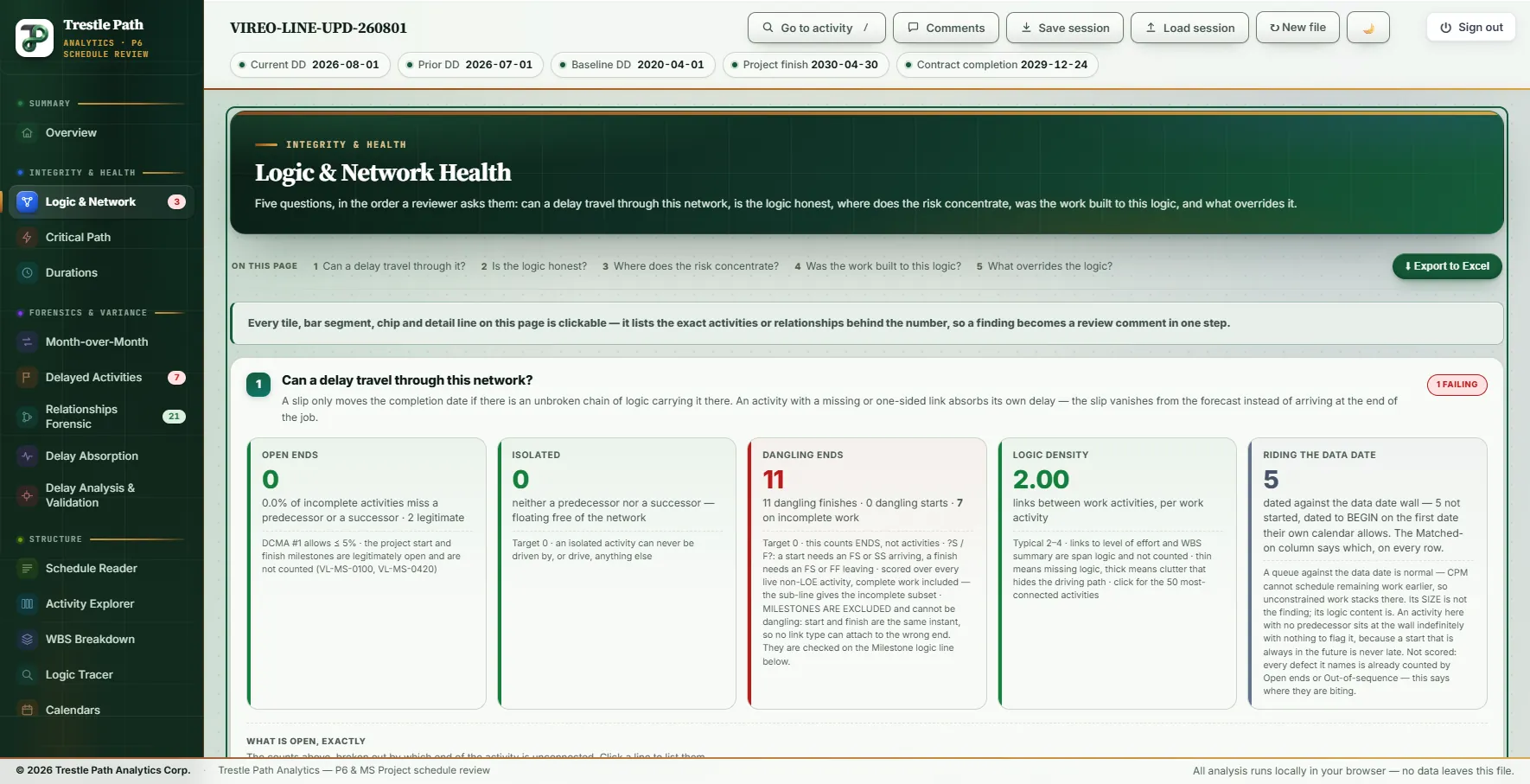
| Check | Measured | What to make of it |
|---|---|---|
| Open ends | 0 of 77 · 2 legitimate | Pass. Notice to Proceed (VL-MS-0100) and Revenue Service Date (VL-MS-0420) are the project's own start and finish. |
| Isolated | 0 | Pass. |
| Dangling ends | 11 finishes · 0 starts · 7 on unfinished work | Fail. All 11 leave only by SS links. Three are critical testing activities at zero float: static testing (VL-TC-7000), high-speed dynamic testing (VL-TC-7030) and systems integration testing (VL-TC-7050). |
| Milestone logic | 4 of 25 milestones | The two project milestones, and two finished milestones with no successor. No start-to-finish ties. |
| Logic density | 2.00 | Inside the typical range. |
| Riding the data date | 5 of 77 · logic clean | Four elevator and escalator installations and the tunnel fibre backbone, dated to 2026-08-03. None lacks a predecessor or waits on an open feeder. |
| FS share | 74.2% of 178 | Fail. 15.8 points short of 90%, which is 29 relationships; the other 46 are 44 SS and 2 FF. Over all 419 links the share is 64.0%. |
| Start-to-finish, leads | 0 · 0 | Pass. |
| Lags | 43 · 24.2% | Fail. Every one is an SS lag, from 28 to 150 days. The testing activities on the critical path are joined by SS links with lags of 45 to 60 days. |
| Merge and burst points | 11 · 1 critical · 3 burst | The critical merge is the tunnel invert, walkway and drainage (VL-TF-4400), fed by both TBM retrievals and the cross passages. The largest burst, the tunnel handover for trackwork (VL-MS-0230), has 7 successors. |
| Duplicate links | 0 | Pass. The 20 pairs carrying both an SS and an FF are ladder logic, not duplicates. |
| Out-of-sequence | 2 · 0 severe · 0 critical · 1.4% of 147 started | On watch. The Rookery Point elevators and escalators (VL-RP-3150) started on 2026-07-23 while their FS predecessor, temporary platform access and works protection (VL-RP-3180), has not started. The instrumentation and settlement monitoring level of effort finished on 2026-07-10, ahead of the cross-passages-complete milestone it is tied to by an FF. |
| Constraints | 5 · 0 hard · 2 late-date · 3 early-date | Finish On or Before on Substantial Completion (2030-01-31) and Revenue Service Date (2030-09-30); Start On or After on three activities. No Expected Finish dates. |
Limits
- It reports; it does not repair. Writing the missing half of a dangling pair, or removing a redundant link, is the Dangling Logic Repair and Redundant Logic Cleanser module.
- Counts are not verdicts. Merge and burst points, density and the data-date queue carry no target, and whether a long lag is acceptable depends on what it stands for.
- The out-of-sequence rule reads status, not lags. A successor that started after its predecessor finished but inside an FS lag is not counted.
- Retired scope is set aside. Activities under a WBS named as retired, inactive or deleted are excluded from every count and listed at the foot of the page; links into them still count as logic for the open-end test.
- MS Project XML. Logic on summary tasks is listed, not analysed, so a task under such a summary can read as open-ended. Elapsed and percent lags are carried as fixed working time.
Where to find it
Logic & Network Health is included in the Analyst and Expert plans and in the fourteen-day trial. Current prices are on the pricing page. The page carries its own reading guide, How to read this page, at the foot. For the critical path the logic produces, see critical path, longest path and float paths.
Fourteen days free
Try it on your own schedule
Fourteen days free, no credit card, every section open. Your XER or XML file is read in your browser and never uploaded; only anonymous numbers reach the calculation service, and nothing is stored.
RelatedDangling and redundant logic in P6DCMA 14-point assessmentCritical path, longest path and float paths